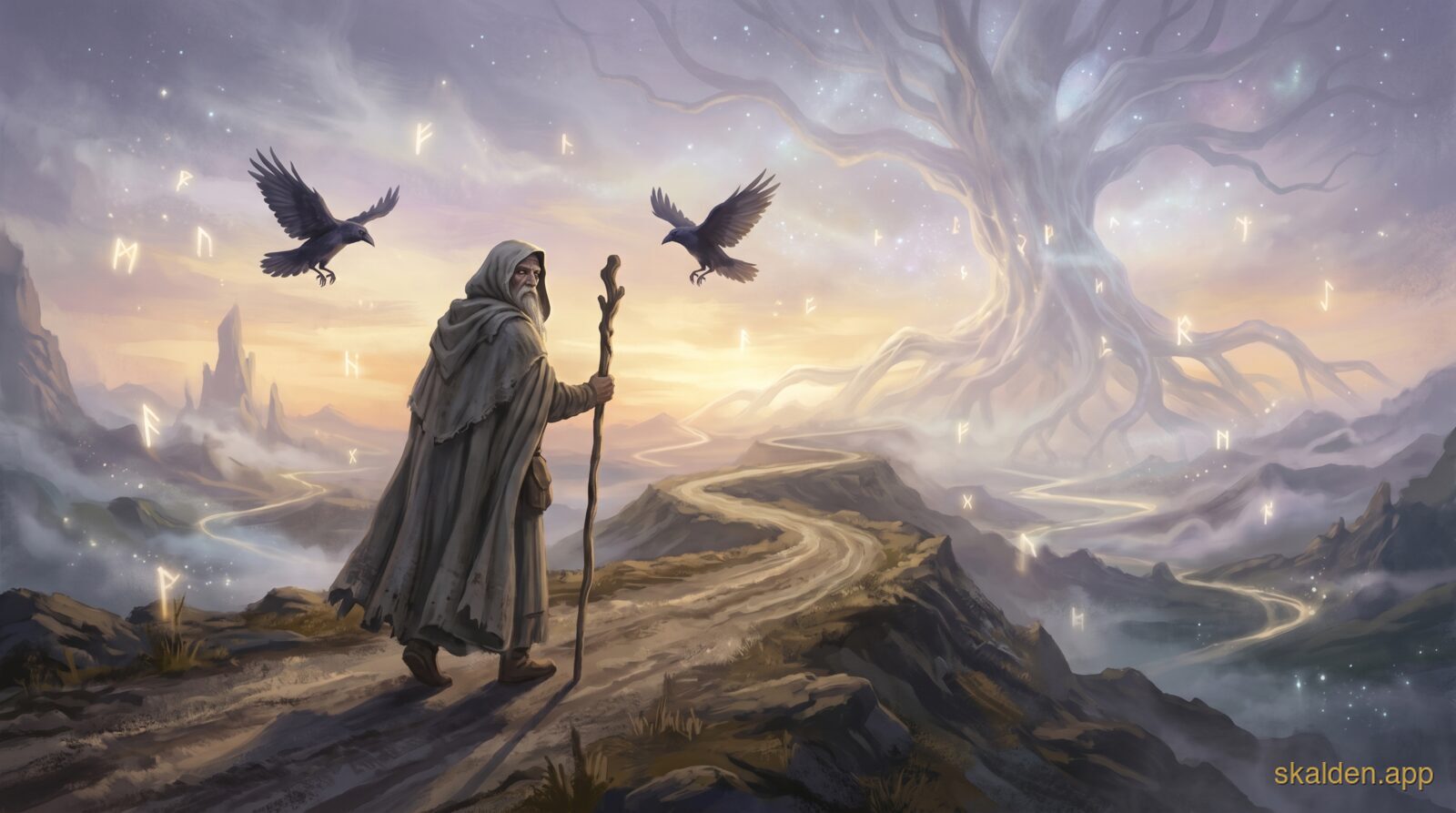
Who is Óðinn, really? The All-Father the sources actually describe
Who is Óðinn, really? The All-Father the sources actually describe
Ask most people to picture Óðinn and you get a king on a high seat — grey-bearded, commanding, thundering down judgement. The Óðinn of the actual sources is stranger, harder, and far more interesting than that.
A wanderer in a borrowed name
In the Poetic Edda and the Prose Edda, Óðinn is rarely on a throne. He is on the road — hooded, one-eyed, walking the nine worlds under dozens of borrowed names (Grímnir, Gangleri, the Masked One). He trades an eye at Mímir's well for a single draught of wisdom. He hangs himself on the world-tree, wounded by his own spear, for nine nights to win the runes. The All-Father does not inherit his wisdom. He pays for it, in pieces of himself.
"I know that I hung on a windy tree / nine long nights, / wounded with a spear, dedicated to Óðinn, / myself to myself." — Hávamál
A god who deceives
He is also a deceiver, and the sources do not hide it. He breaks oaths. He stirs wars for his own ends — he needs the bravest of the slain in his hall, Valhǫll, for the last battle, and he is not above starting the fights that send them there. The Hávamál, the long poem of his advice, is not gentle wisdom literature. It is the hard, watchful pragmatism of someone who has been betrayed and expects to be again: guard your words, trust slowly, and know that a guest's welcome wears thin.
A god who knows he will lose
The thread that makes Óðinn tragic rather than merely cunning is this: he knows how it ends. He has read Ragnarök on the wall of every hall. The wolf Fenrir will break its chain and swallow him whole. And he gathers his warriors and sharpens his plans and walks toward that end anyway, eyes open. That is the heart of him — not power, but the will to act in the teeth of a doom he cannot escape.
How we know any of this
A word of honesty, which Skalden insists on. Everything above comes through a medieval Christian-era reconstruction. Snorri Sturluson set down the Prose Edda around the year 1220 — two centuries after Iceland left the old gods — and the older poems survive in one battered manuscript, the Codex Regius, copied by Christian hands. So this is an echo pieced from what survived a faith's ending, not a scripture handed down whole. That it reached us at all is its own small wonder. Knowing it is patched and partial is the beginning of reading it well.
In Skalden, you can ask Óðinn himself about any of this — and ask him for the verse behind the voice.