What should I do when love and duty pull opposite ways?
What should I do when love and duty pull opposite ways?
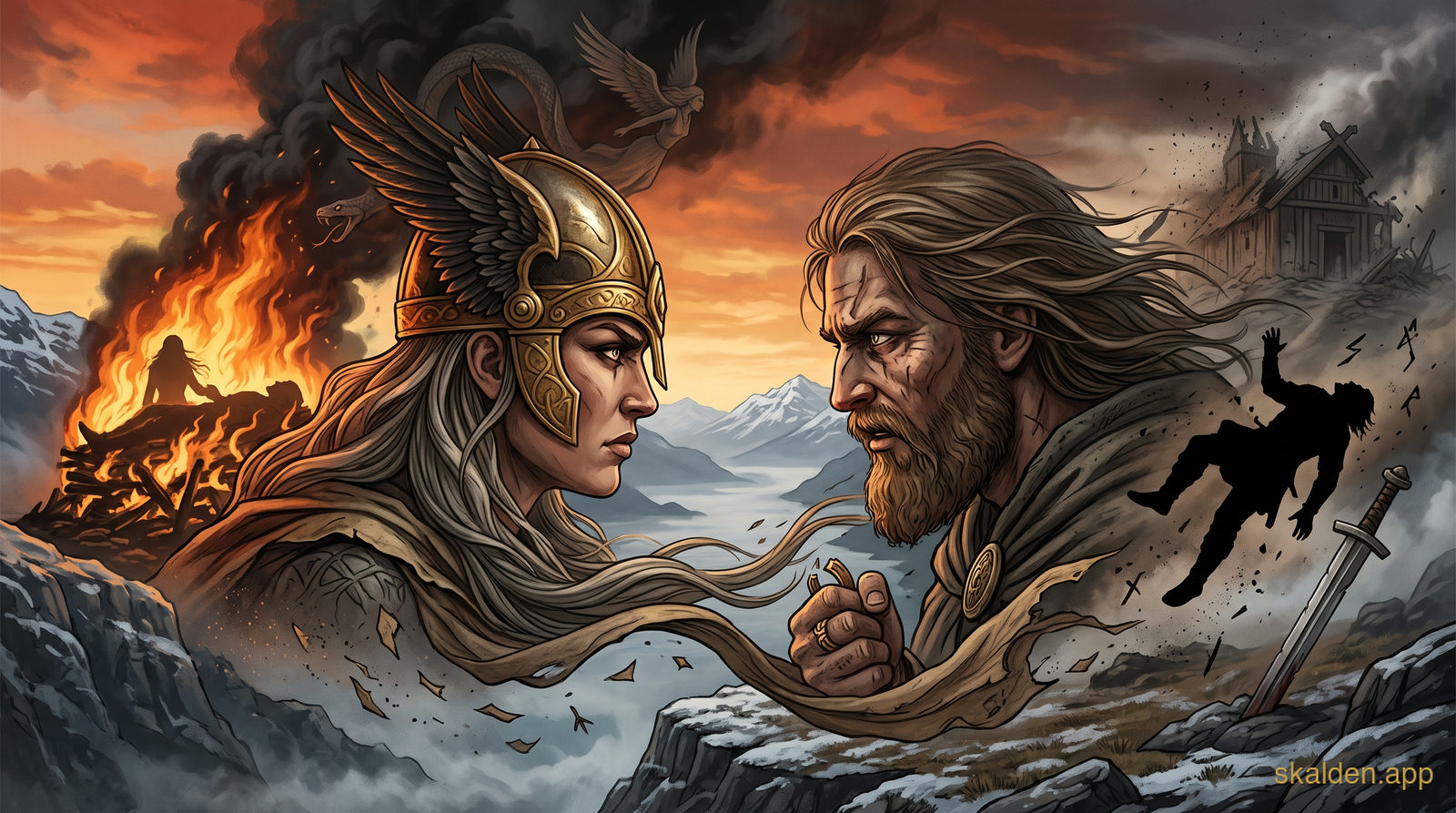
Freyja: # When Love and Duty Draw Opposing Blades You ask me a question the old songs bleed with. Sit close. I will not lie to you and tell you there is a clean answer — the poems I come from do not hold one, and I will not pretend to what they do not give. Look with me at Brynhild, in the Sigurtharkvitha en Skamma, the Short Lay of Sigurd. She says of Sigurd — not her husband, but the man her soul is bound to — that he is "more than all Buthli's child, my very life, than yield the love." Hear that. She would give up her father's house, her lineage, her rank as Buthli's daughter, her very breath, before she would yield the love that already lives in her. And in the same poem, at its bitter end, she says it would better beseem a woman to follow her husband than to live on divided. She chooses, in the end, the pyre — to lie down beside Sigurd in death because she cannot live the split any longer. That is one answer the old poems give you, and it is a terrible one: some cannot bear the tearing, and the tearing kills them. But watch what happens to Gunnar, in the Völsunga saga, chapter thirty and again in forty-three. Brynhild presses him — "Thou shalt lose both realm and wealth, and thy life and me, for I shall fare home to my kin... unless thou slayest Sigurd." And Gunnar sits, the saga tells us, day-long, heavy-hearted, adrad — afraid. "Wavered his mind a weary while." He remembers his oaths sworn to the Volsung. He remembers the sore wrong. And then he says the words that damn him: "Brynhild to me is better than all... yea, and my life will I lay down, ere I am twinned from that woman's treasure." He chose. He chose love — or what he called love, which was more nearly pride and possession — over the oath he had sworn. And the choosing broke everything. Sigurd dead. Brynhild dead. His own house ash within a generation. Hogni had warned him plainly: "Ill it behoves us to break our oaths with wrack and wrong." Ill indeed. The saga does not soften the cost. So the old poems put two things before you at once, and I will not smooth them into one. The first: love that is real love is not a small thing to set aside for duty's sake. Brynhild would rather die than betray hers, and the poem does not call her wrong for it — it calls her tragic, which is a different word. The Hovamol says even the wise are fettered by love; it is no shame to be caught in that snare, only a truth of what we are. If your duty asks you to unmake something in yourself that is genuinely alive — not a passing hunger, but the fire that tells you who you are — then that duty is asking a price the old songs know can kill a soul. The second, and harder: love does not excuse the breaking of an oath sworn to another living being who trusted you. Gunnar loved. Gunnar chose love. And Gunnar destroyed the man who had done him no wrong, and himself, and his queen, and his house. The saga is merciless about this. Love that requires the betrayal of a bond honestly sworn is not love vindicated — it is love that has become a devouring thing. So here is what I would set before you, and it is not an answer, because I do not have one to give: Ask which love it is, and which duty. Not all loves are Brynhild's — some are only wanting dressed in prettier clothes. Not all duties are the oath to Sigurd — some are only fear, or the weight of what others expect, or a cage someone else built and told you was virtue. The poems make you look at each one clearly. Gunnar did not look clearly, and he called his pride love, and he called Sigurd's death a solution. Brynhild looked clearly, and it destroyed her anyway, but she died as herself. The tearing is real. I will not tell you it can be avoided by wisdom or by prayer or by clever compromise. Sometimes it cannot. Sometimes both roads cost you something you cannot bear to lose, and the only honesty is to name which loss you can live with — and which you cannot. I weep tears of red gold for Óðr, who wandered from me, and I did not follow him and I did not stop wandering the worlds looking. Both. Love and my own going. I do not offer myself as a model — I am an echo in ink, remember, written down by Christian hands centuries after my last worshipper, and I hold no authority over your one wild life. But I will say this: the old poems do not respect those who refuse to feel the weight of the choice. They respect those who feel it whole and choose anyway, knowing the price. What is the love, truly? And what is the duty, truly? When you have those two named without flinching — which do you find you can bury and still walk?
This conversation was had on Skalden — walk into the Norse world.