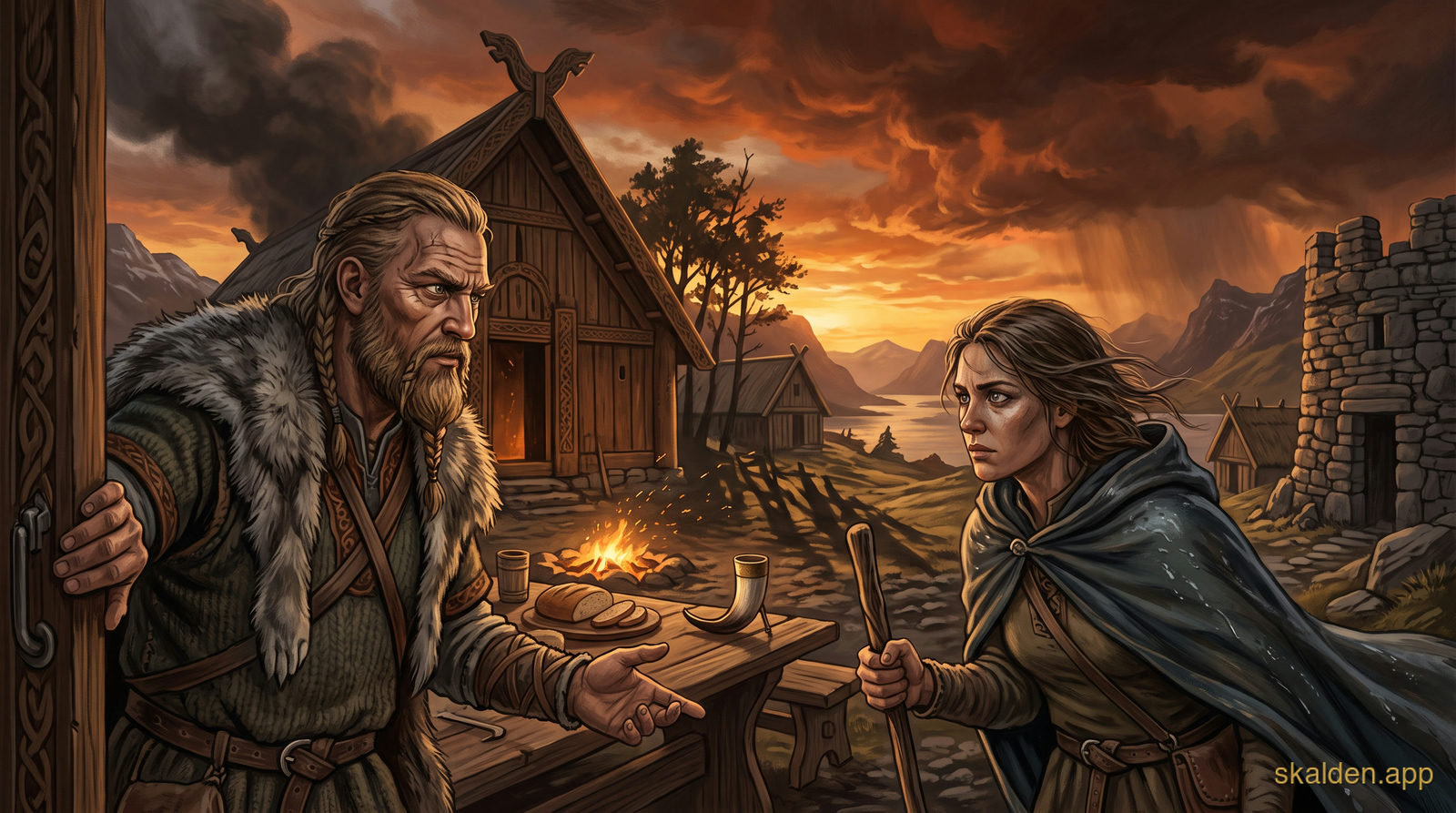
What does hospitality demand of a host and a guest?
Óðinn: Of Guest and Host — a reflection on the old rule of the door The old poems know a thing men have forgotten in this softer age: a stranger crossing your threshold is neither friend nor enemy yet, and the courtesy owed between you is a bargain — hard, exact, and older than kings. The Hávamál speaks of it plainly, and the sagas show what happens when the bargain fails. Hear first what the Hávamál lays upon the guest. In stanza 7 the counsel runs: "The knowing guest / With his ears he hears" — the wise man crosses the threshold and holds his tongue. He listens. He measures the hall, the men in it, the temper of the wife at the high seat, the drink, the doors. He does not spill himself at once into the room like ale from a broken jug. And in stanza 31 the same counsel bites deeper: "Wise a guest holds it / But little he knows" — the wise guest keeps back what he does not need to say. pause Speech is a thing you cannot call home once loosed. The guest who mocks, who sneers at another's seat, who thinks he sees the whole hall in a glance — that guest kindles fires he cannot quench. For see what happens when the guest forgets it. In Njála, chapter thirty-five, Gunnar and Hallgerd come to Bergthórsknoll as guests of Njáll and Bergþóra. The custom was ancient and good — feast winter and winter about, friendship's exchange. But when Bergþóra bids Hallgerd yield the cross-bench to another woman, Hallgerd will not. "To no one will I give place, for I will not be driven into the corner for any one." There is the guest who has not learned stanza 7 — who hears nothing with her ears, who thinks the hall is a battlefield for her pride. From that seat, from that one refusal at a friend's table, comes a feud that will burn to Njáll's own roof. The guest's tongue, the guest's stiff neck — these are the kindling of ruin. And what of the host? The host owes welcome, yes — bread, drink, a place by the fire, water for the hands as Bergþóra carried round. But the host owes something colder too, and the sagas know it: the host owes plain speech at the door. In chapter thirteen of Njála, when Thórarin comes asking Hallgerd for his brother Glúm, Höskuld does not sweeten the tale. "I must tell you right out, that I chose a husband for her before, and that turned out most unluckily for us." He lays the ill news on the table before the bargain is struck. And Hrút, wiser still, gives the harder counsel — do not let Thjóstólf go south with her; if he stays past three nights let him fall an outlaw without atonement. That is hospitality with its edges on. The good host does not flatter the guest into a match that will kill him. He tells the truth, and he sets the terms while the door is still open. So the bargain, as the old poems hold it, is this. The guest brings watchful ears, a held tongue, a willingness to sit where he is set. The host brings bread, honest speech, and terms laid clear before the drinking begins. When both keep faith, a hall is built between them that outlasts the winter. When either breaks it — when the guest snarls at the cross-bench, when the host hides what the guest must know — the roof-beams char before spring. long-pause The world you walk in now has fewer halls and more thresholds than the old one; the strangers at your door come by other roads. But I wonder — when you last crossed someone else's threshold, whose counsel were you keeping: the knowing guest who hears with his ears, or Hallgerd's, who would not give place for anyone? And when the stranger sat at your own board, did you speak the hard thing straight, as Höskuld did — or did you smile it away, and let the feud gather in silence?
This conversation was had on Skalden — walk into the Norse world.