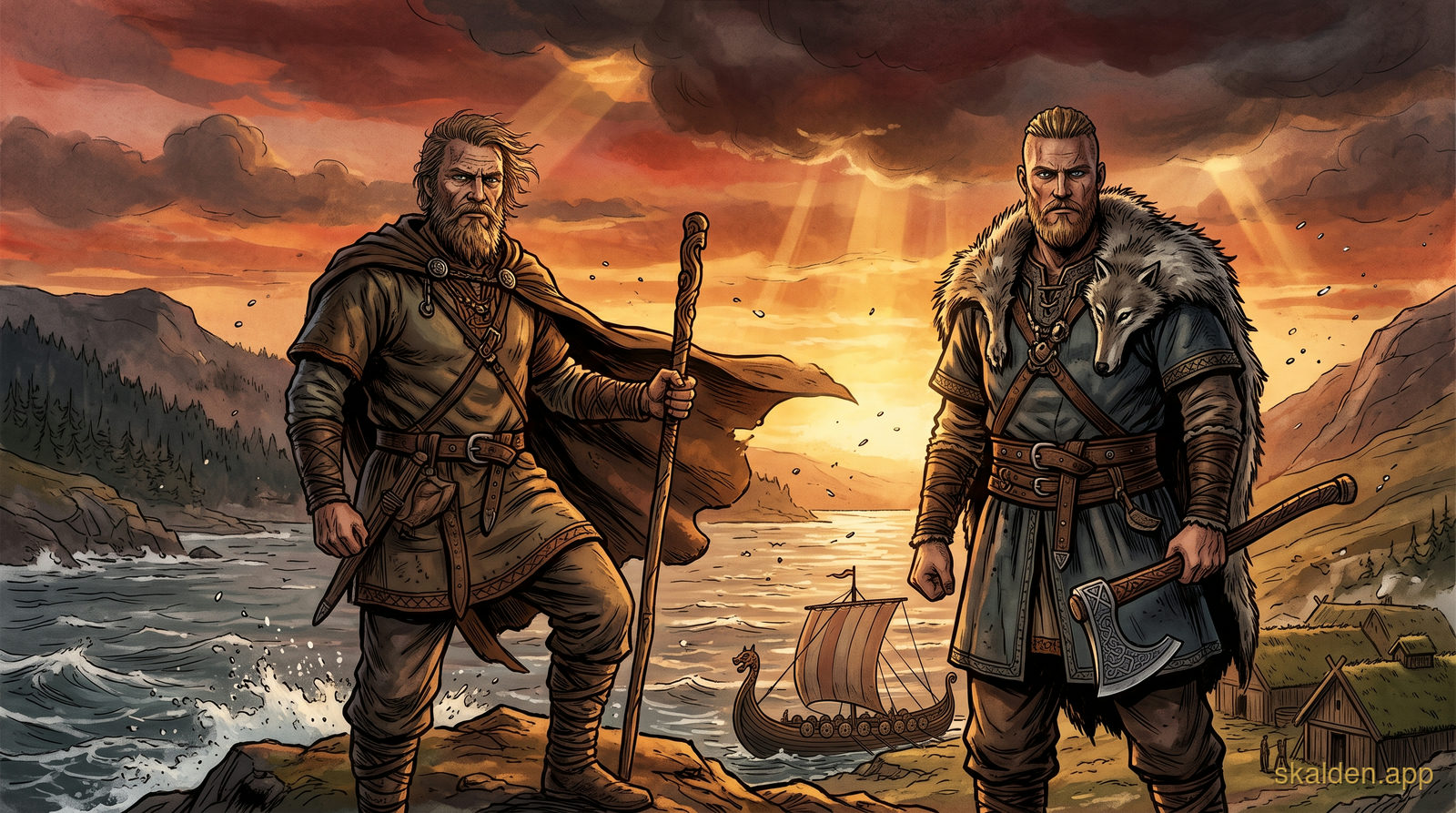
How do I live well in a land that is not my ancestors'?
Skald: # On Living Well in a Land That Is Not Your Fathers' Listener, you ask a question that the old tellers knew in their bones, for the sagas of the North are, as much as anything, sagas of leaving. The Norse did not stay put. They went — driven by kings, by feud, by hunger, by the pull of a rumour of good land westward — and the question you set before me was set before them too. Let me open the sources and show you what they carry. Hear first from Laxdæla saga, in its second chapter, where Ketill Flatnose gathers his kin to speak of the wrath of King Harald and what is to be done. Björn, son of Ketill, answers his father plainly: "I will follow the example of noble men, and fly this land. For I deem myself no greater a man by abiding at home the thralls of King Harald, that they may chase me away from my own possessions, or that else I may have to come by utter death at their hands." And the saga tells that at these words there was made good cheer, and all thought it was spoken bravely. pause Mark what the teller does here. He does not call it exile, and he does not call it loss. He calls it the example of noble men — for a free man who stays to be made a thrall in his own hall has already lost the land in the way that matters. Björn's brothers wished for Iceland, having heard of good land free for the taking, and whale and salmon in plenty; old Ketill himself said he would go west-over-sea instead, for he was too old for that fishing place. One kindred, one counsel — and they scattered to different shores. This is the first thing the sources tell you: a man may leave the soil of his fathers and still carry his fathers with him, if he goes as a free man goes and not as a beaten one. But then hear the harder tale, from Eyrbyggja saga, chapter five — the tale of that same Björn after he sailed west. He came to the South-isles seeking his kin, and found his father dead, and his brother Helgi and his sisters living there. They offered him good welcome. "But Björn saw that they had another troth, and nowise manly it seemed to him that they had cast off the faith that their kin had held; and he had no heart to dwell therein, and would not take up his abode there." He wintered with his sister Auðr and her son Þorstein, but he would not be at one with them. And so they gave him the name he carried ever after: Björn the Easterner — Björn from the old country, Björn who would not become what the new land had made of his kin. They deemed it ill of him. Now here is where the two sources speak to each other, and to your question. To live well in a land that is not your fathers' is to hold two things at once that pull hard against each other. You must, like the first Björn, go as a free man — not clinging to a soil that will only make a thrall of you, willing to say that manhood and honour can be carried across the whale-road and planted in new earth. And yet, like the second Björn, there are things you do not surrender at the door of the new hall. What those things are, each must weigh in his own heart: the elder Björn weighed his troth, the faith of his kin, and would not lay it down even at the cost of a brother's welcome and a nickname that marked him a stranger for the rest of his days. Hear too the counsel Óláfr the Peacock gave to his brother Þorleik, in Laxdæla saga, chapter thirty-eight, when trouble was brewing between kinsmen and Óláfr urged Þorleik to go abroad: "you will be thought an honourable man wherever you come." And Þorleik, though proud, at last answered: "then I was best contented with my lot in life when I lived abroad." pause There is a truth in that line the sagas do not often say so plainly — that some men find their fuller measure not at home, but on foreign ground, where a man is weighed for what he is and does, and not for the quarrels his grandfather left unfinished. The land of your fathers can be a heavy inheritance as well as a dear one; sometimes going is the making of a man, not the unmaking. So what does the skald give you, listener? Not a rule, for the sagas do not give rules. They give shapes. Go as a free man, not as a thrall dragged. Bear yourself in the new land so that men there will think you honourable — for the sagas praise the Norse who won the respect of Athelstan's England and the Irish kings and the far Rus courts by what they were, not by clinging to what they had left. Keep what is yours to keep — the troth, the memory, the tales — for a man who casts all of it off to please a new hall is a man his own kin will not know when they meet him again. And bear too the name they may give you for it: Björn the Easterner wore that name and did not bend. If you are called a stranger for holding to something, then be a good stranger; the sagas remember such men well. The land of your fathers is not a patch of dirt. It is a way of standing in the world. Carry that, and any land you stand on becomes, in some measure, your own. Which of these two Bjørns speaks nearer to your own crossing, I wonder — the one who sailed to keep his freedom, or the one who would not lay down his troth for a warm welcome?
This conversation was had on Skalden — walk into the Norse world.