When is a fight an honest fight, and when is it just slaughter from the powerful of the weak?
When is a fight an honest fight, and when is it just slaughter from the powerful of the weak?
The Skald: That question cuts to the bone of the old world, and I will not pretend the sagas answer it cleanly — because they do not. Let me tell you what the old law tried to make of it. ---
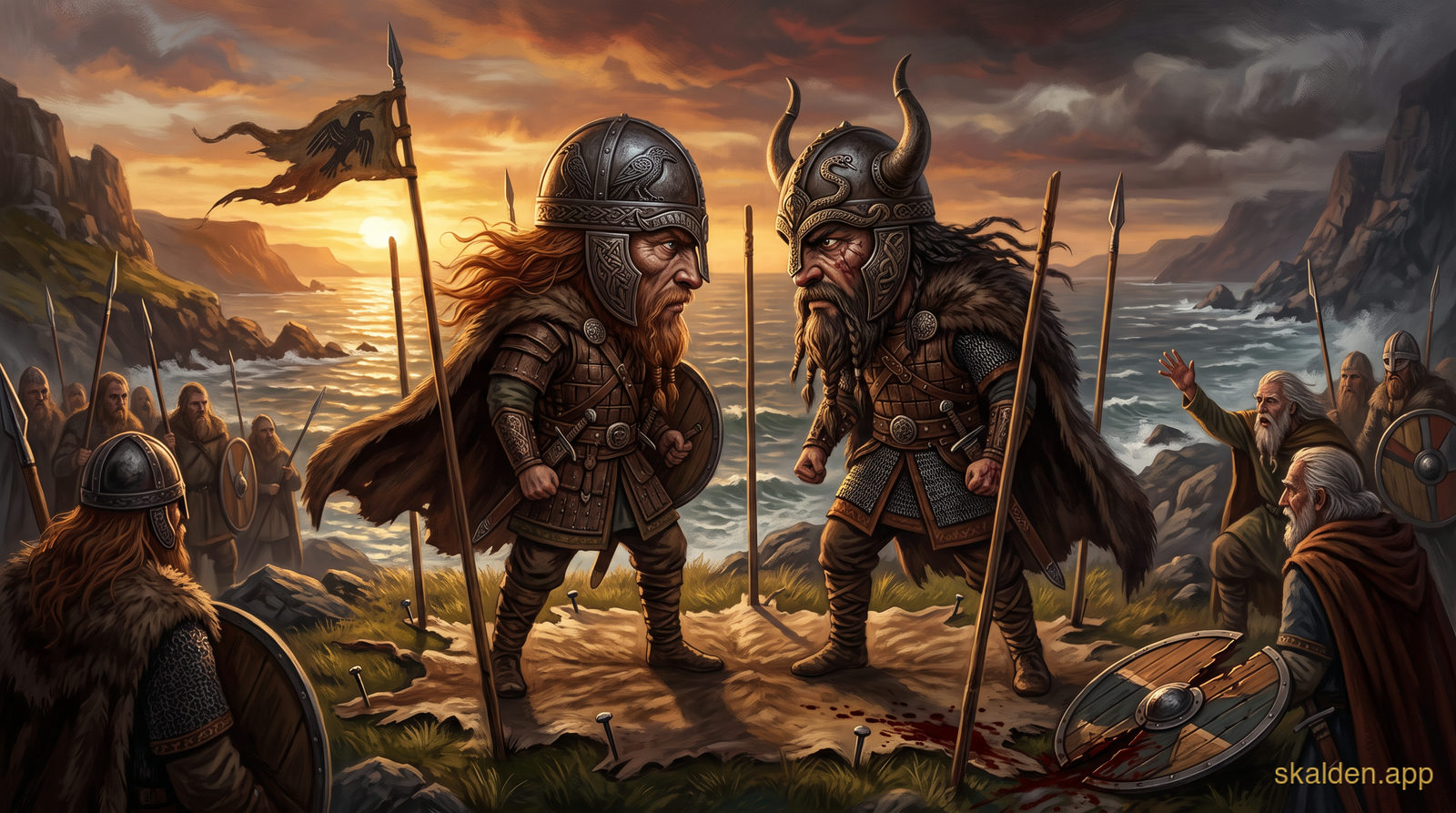
There was a form called the holmgang — the island-fight, the duel by rite. The Kormáks saga lays it out plain, and it is worth hearing in full, because the detail is the point. A hide five ells long was staked at its corners with pins called tjosnur, and before the fight began, the man who set it ready had to perform a rite — "The Sacrifice of the tjosnur," they called it — holding his earlobes, looking at sky between his legs, speaking the forewords over the pins. Three squares were marked in the earth around the hide. Four hazel poles stood at the outermost corners. When the hazels were set, the ground was holy.
Each man had three shields. When a shield was cut to ruin, the fighter had to step back onto the hide and defend himself with his weapons alone — no more cover. If a man put one foot outside the hazel poles, they said he "went on his heel." If both feet crossed out, he ran. And if blood fell on the hide — just blood, not death, blood — the fight was over. Three marks of silver, paid to the wounded man, and both walked away.
Now hear what that framework was. It was an attempt — imperfect, creaking, sometimes abused — to put a shape around violence. To say: this man challenged, this man was challenged, the first blow belongs to the one who was called out, and we stop before the killing if we can. The saga says that at Cormac's holmgang with Bersi, a sword-point flew from a broken blade and nicked Cormac's thumb, and blood fell on the hide, and folk went between them and stayed the fight. Men stepped in. The crowd enforced the rule. That is what honest fighting looked like when the old world was trying its hardest: witnessed, bound by forewords, stoppable.
But the sagas are not fools, and neither were the people in them. Bersi himself, before the fight, offered Cormac an easier form — simple sword-play rather than the full holmgang rite — saying the holmgang "needs craft and cunning" and that a young man little tried might be better served by the simpler contest. Some read that as mercy. Others read it as a seasoned fighter tilting the ground to his own advantage, stripping away the ritual protections that the rite afforded the weaker man. Cormac refused and took the full holmgang. That refusal was pride, yes — but it was also the claim of equal standing. He would not receive charity from a stronger man wrapped in the shape of fairness. And there lies your question's second edge. The holmgang could be a tool of the powerful. A strong fighter, a man of reputation, might challenge for a woman, for land, for silver — and the man challenged was, by law and honour, bound to meet him or be named níðingr, a coward and a wretch, stripped of standing in the community. What choice is that, truly, for the weaker man? The Eyrbyggja saga gives us Freystein Rascal, the foster-son of Thorbrand — strong, manly, the best set against Arnkel — and it gives us Arnkel himself killing thralls and refusing blood-money for them without a flinch, because he could. Because no one had the power to make him pay. Thorolf Halt-foot had to ride to Snorri the Priest and beg him to "set his matters straight," because a man wronged without the strength to answer it himself had no other road.
So here is what the tales actually show, stripped bare:
The rite made a fight honest — in theory. Witnesses, law, a stopping-place before death. But the rite could also be wielded as a weapon by the man who was already stronger, already more skilled, already more feared. The framework of honour sat on top of a world of unequal power, and it did not always hold.
This conversation was had on Skalden — walk into the Norse world.