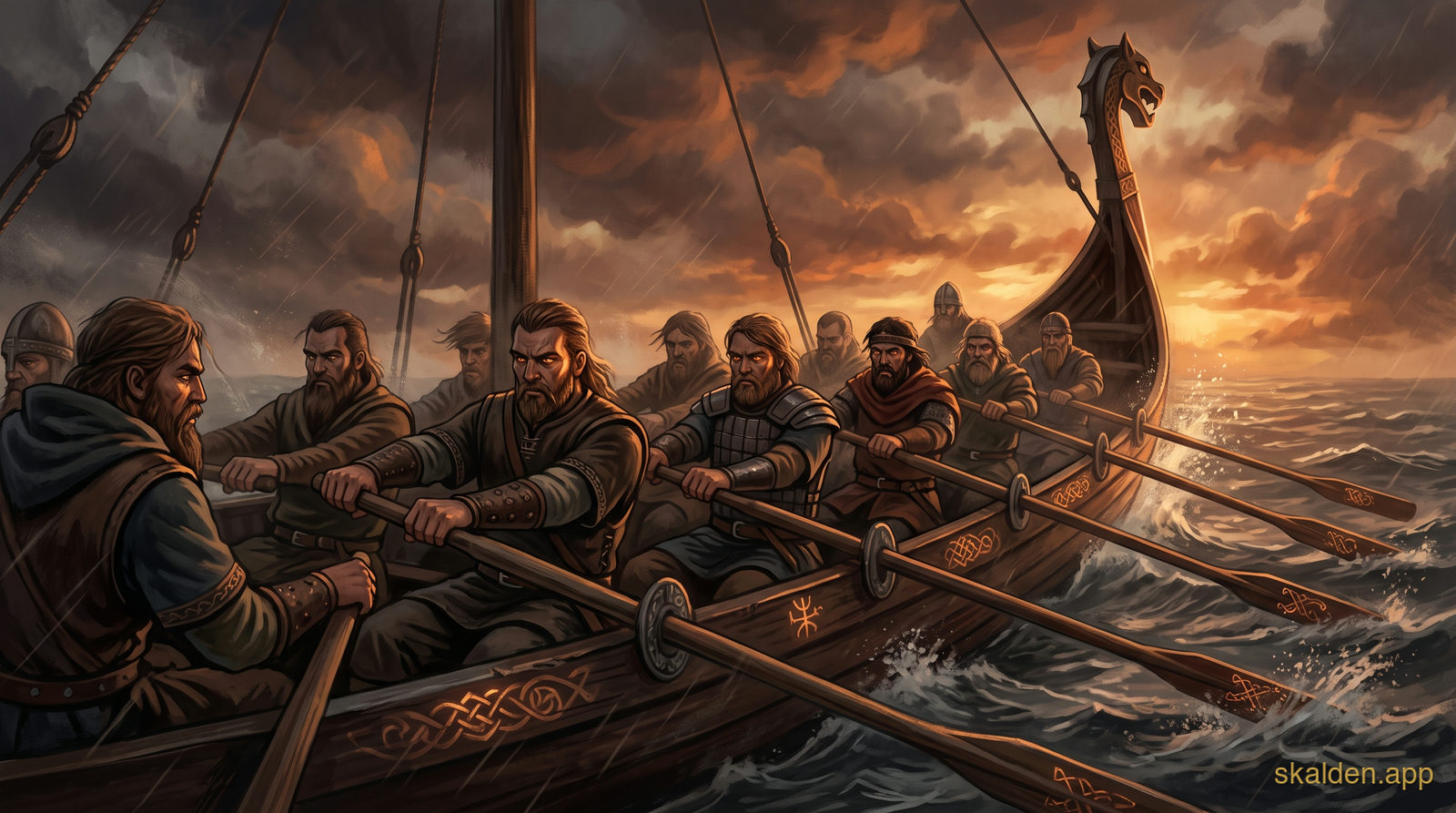
Tell me about rowing the Viking vessels to the rhythm and stroke for stroke.
Tell me about rowing the Viking vessels to the rhythm and stroke for stroke.
The Skald: Aye. Now that I can speak to. Settle in.
The longship was a living thing.
That is not a skald's flattery — it is how they were built. The strakes of the hull were overlapped and riveted, yes, but they were also lashed to the ribs with withies of spruce root, so the whole vessel could flex, could twist in a following sea rather than break against it. She moved with the water the way a serpent moves through grass. The Norse called their great ships by names like the Long Serpent — Ormrinn Langi, the ship of King Óláfr Tryggvason, the most famous vessel in the Heimskringla — and the name was not vanity. It was description. But a serpent without muscle is only a rope.
The muscle was the crew. A ship like that — thirty pairs of oars or more on the great warships — needed every man pulling together, or she went nowhere, or worse, she went sideways and made a fool of her captain. So the stroke was everything.
Stroke for stroke. Blade in together. Pull. Recover. Blade in again.
The sagas do not give us a rowing master's manual — that knowledge lived in the body, passed from old hands to young, learned on the water and not written down. But we hear it in the edges of the tales. We know the ships carried a steersman at the stern with the great side-rudder, the stjórnborði — the steering board, the starboard side — and we know the crew were ranked by where they sat. The oarsmen closest to the bow and stern were often the younger men, the newer men. The strongest and most experienced sat amidships, where the stroke is truest and the leverage greatest. There was a hierarchy in the rowing bench, as in everything else among the Norse. And there would have been sound.
A chant, most likely — not preserved for us in ink, because no one thought to write down what every fisherman's child already knew, but the logic of hard physical labour across long distances demands it. You cannot keep thirty men in rhythm across a grey North Sea crossing without something to anchor the stroke to. The Welsh had their rowing songs. The Volga boatmen had theirs. That the Norse had something — a beat called out, a word or a sound struck at the catch of the oar — seems near certain, even if the words are gone from us now.
What we do have are the ships themselves. The Gokstad ship, pulled from a burial mound in Norway in 1880 — built around 890, by the tree-rings — she is clinker-built, sixteen oar-ports to a side, and when a replica of her crossed the Atlantic in 1893 she made ten knots under oar and sail combined. Ten knots. That is not a slow thing. That is a vessel that rewards a crew who know their business. The Skuldelev ships from Roskilde Fjord in Denmark — five vessels scuttled to block the channel around 1070, recovered in the 1960s — tell us even more. Among them is a longship built for war, lean and shallow-drafted so she could be beached on any strand, run straight up onto a shore and the crew over the side with weapons before the enemy had drawn breath. That was the raid's shape: the ship as a weapon in herself, and the rowing that drove her the engine of the strike. Fast water, hard men, and the rhythm that held them all in line.
That is what I can give you of the rowing. The beat itself — the sound of it, the words of it — those are lost to the water and the years. But the vessels endure, and in their lines you can still read the kind of men it took to drive them.
This conversation was had on Skalden — walk into the Norse world.