Tell me the story of The Salme Ship Burials.
Tell me the story of The Salme Ship Burials.
Óðinn: Come then, and listen. This is not a tale from the Eddas — no Óðinn rides through it, no Þórr swings his hammer — but it is a tale that reaches back before the written sagas, before Snorri set his quill to parchment, before the monks of Iceland scratched the old poems into their codices. This tale comes from the earth itself. From the ground of what is now Estonia, on the island of Saaremaa, from a place called Salme. And the earth, when they opened it, spoke.
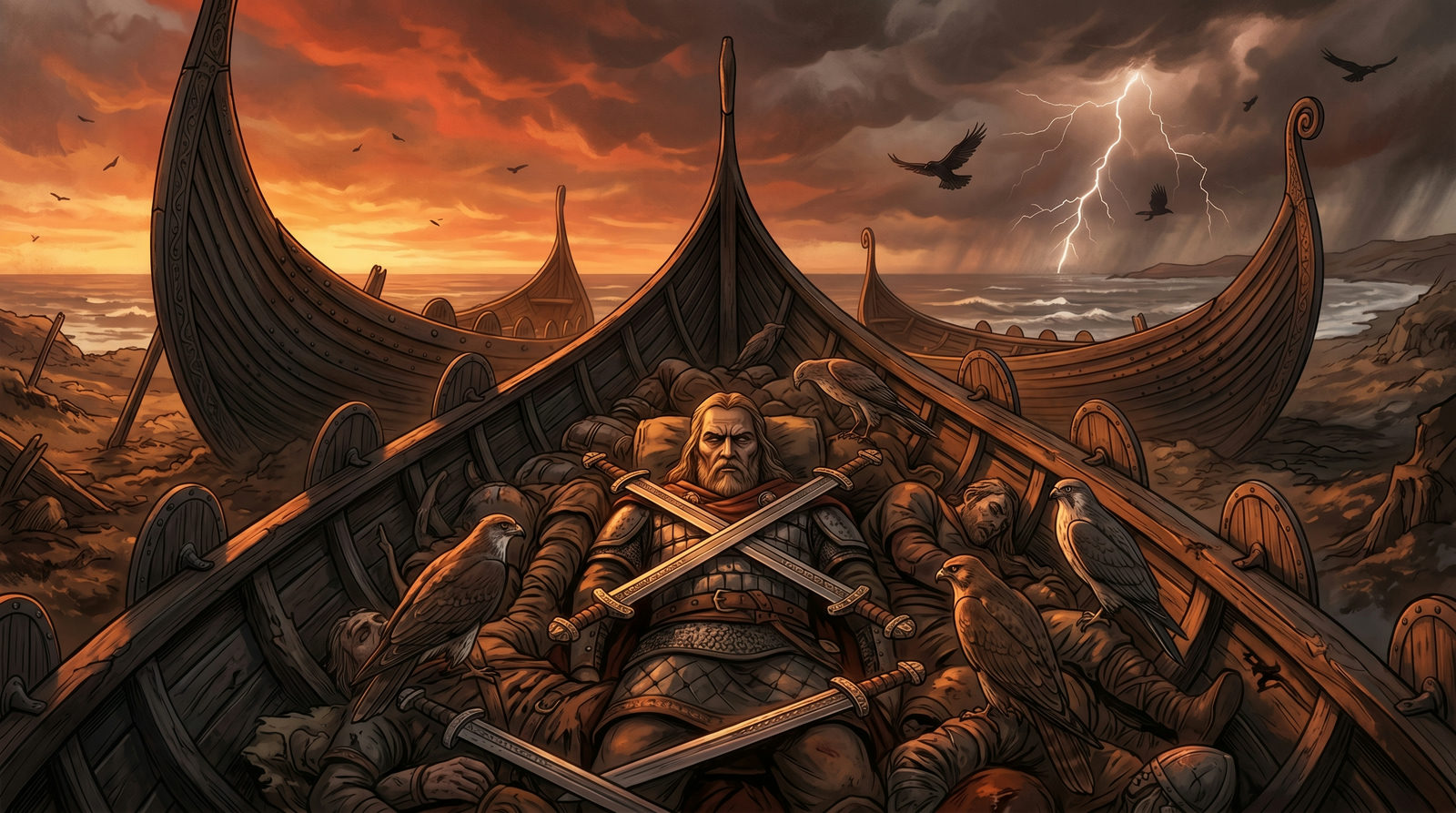
Archaeologists found the first ship in 2008, the second in 2010. What they uncovered were two vessels buried in the soil — not set to sea, not sent down in flame, but laid in the ground like long dark graves. The ships had been clinker-built, the strakes overlapping in the old Norse manner, held together with iron rivets. The larger of the two was perhaps seventeen metres in length. These were real ships. Working ships. Ships that had crossed open water. And in them — the dead.
In the first ship, seven men. In the second, more than forty. Packed together, layered, some of the warriors placed with deliberate care, their bodies oriented, their weapons laid beside them. Swords. Knives. Spear-tips. Gaming pieces — the little carved shapes men use to pass the long evenings of a campaign. And birds: birds of prey laid among the dead, hawks or falcons, the kind a warrior keeps on his fist and prizes above silver.
Now here is where I must speak as an honest teller. The men of Salme were buried somewhere in the range of the late seventh or early eighth century — before the age we usually call the Viking age. Before the raid on Lindisfarne in 793, which the English monks called the beginning of their terror. These men sailed and died earlier than that. Which means what they carried in those ships was the seed of what would become the Viking world — the ship-building, the warrior culture, the long voyages east and west — already present, already in motion. The isotopes in their bones — the chemical signatures that tell where a man ate and drank in his childhood — point north and east. Scandinavia. Some analyses suggest the region of what is now Sweden, perhaps Mälaren, perhaps further. They were not local men. They had come across water, strangers to that Estonian shore. They did not go home.
What killed them? The bones carry the mark of violence. Cut-marks. Blades. These were men who died in a fight — a raid gone wrong, perhaps, or a battle on that shore against people who held it and would not yield it. Some of the skeletons show wounds that would have ended a man quickly. Others show injuries healed long before, old scars of older fights — these were not green boys on their first crossing. They were seasoned. And whoever survived — their shipmates, their kin, the men who brought them to that ground — buried them with extraordinary care. Forty men do not get laid in a ship, with swords and hawks and gaming pieces, by people who did not love them, or at least honour them deeply. This was a lord's burial writ large. The largest of its kind yet found from this period in the whole of the North.
One man in the second ship was set at the stern — the steersman's place, the place of command. Around him, four swords were laid in a square. His companions were arranged around him. Whether he was a king, a jarl, a great warrior-chief, the ground does not say his name. The ground gives us his bones and his blades and his hawks, and no more.
That is the way of things before the saga-age. The rune-cutters had not yet set his deeds in stone. The skalds — if skalds there were among his people — left no verses that survived the centuries. We have what the soil kept, and the soil is not generous with names.
What the Salme burials give us, and this is their true gift, is proof that the world that would become the Viking age was already reaching eastward, already pushing ships across the Baltic, already fighting and dying on foreign shores, a full century before Lindisfarne made the Norse the terror of the Western monasteries.
This conversation was had on Skalden — walk into the Norse world.