Tell me the story of Rök Runestone.
Tell me the story of Rök Runestone.
The Skald: Listen, then. There stands in Östergötland, in Sweden, a stone — a great slab of granite, nearly three metres tall — and on its face and sides and back are cut more runic letters than on any other stone that has come down to us. Nearly eight hundred runes. The scholars call it the Rök stone, for the parish of Rök where it was raised, and it was set there — or one very like it — in the manner of the memorial stones of that age. This one dates to somewhere around the late ninth century, perhaps the 800s, and it is written in Old Swedish runes of a kind that tells us something of its age.
Now — I will be honest with you here, as a teller must — the Rök stone is not a Norse stone in the way the Jelling stones of Denmark are Norse stones. It is Swedish. And more than that: it is among the hardest texts the runologists have ever tried to read. The runes are cut in several different cipher systems mixed together — some plain, some in code, some in a kind of riddle-form — and scholars have bent their wits over it for more than a hundred years without reaching full agreement on what it says. But this is what the stone seems to say, or what the most widely held readings give us:
What the Runes Declare
It begins with a grief. A man named Varinn raised the stone for his dead son, Væmoðr. That much is plain. The opening reads, in the rendering most translators give: "In memory of Væmoðr stand these runes. And Varinn wrote them, the father, in memory of his dead son."
A father's grief, cut in stone. That part is simple. But then — then it grows strange and deep.
Varinn does not stop at mourning. He begins to ask questions. Or he poses riddles. The stone says — and here I give you the sense, not a word-for-word rendering, for the runes shift cipher as you read them — something like: "I tell the ancient tale of which of the two war-booty was taken twelve times from men, both together and apart."
What does this mean? That is the quarrel of scholars.
Some have read the stone as a meditation on the legend of Þjóðríkr — the great king who rode on the shore of the sea. Þjóðríkr is almost certainly Theodoric the Great, the Ostrogothic king who died in 526, a man so famous his legend spread north until the Norse told tales of him as a warrior-king among heroes. The Rök stone seems to speak of him: "That Þjóðríkr the bold, lord of sea-warriors, ruled over the shores of the Hreiðsea." The Hreiðsea — the old name for a sea the Goths knew, perhaps the Black Sea or an inland water of the east. So Varinn, mourning his son, reaches back into the deep past — into legend, into the memory of the greatest kings — and sets his son's death against the long story of the world.
Then in 2020, a group of Swedish scholars — Per Holmberg among them — put forward a reading that shook the field. They argued the stone is not chiefly about heroic legend at all. They said: the stone is about Ragnarök.
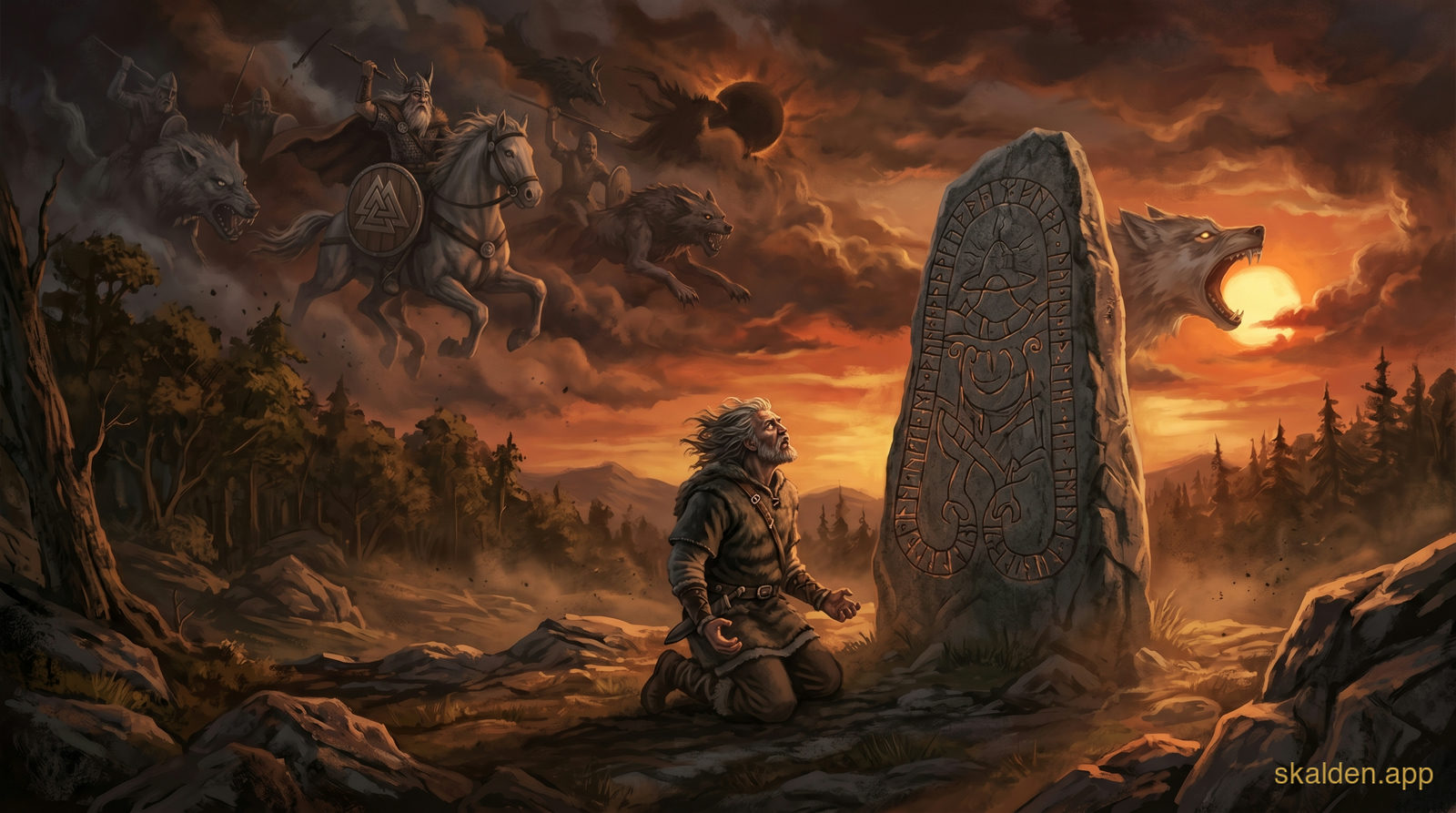
In their reading, Varinn is not merely a grieving father reaching for fame. He is a man writing in a time of terror — in the 800s, when the winters were biting hard, when the sun seemed to fail, when raids and plague and cold pressed on the world. He is asking, in riddle and cipher, whether the darkness will come — whether the great winter, Fimbulvetr, is upon them — and whether his son died at the edge of that end. The riddles of the stone, in this reading, map onto cosmic battles and the creatures of the last age. The twenty kings on their horses — a kenning perhaps for the stars, the Pleiades, that mark the seasons. The one-eyed ancient — Óðinn himself. The hawk of the seasons, the wolf that swallows the sun.
This conversation was had on Skalden — walk into the Norse world.